
Mason bees and honey bees both visit cherry blossoms. Do those visits help more cherries form? A study of 17 commercial sweet cherry orchards in central Germany found a benefit when both groups were present. The researchers followed the flowers long enough to see which ones actually began to grow fruit.
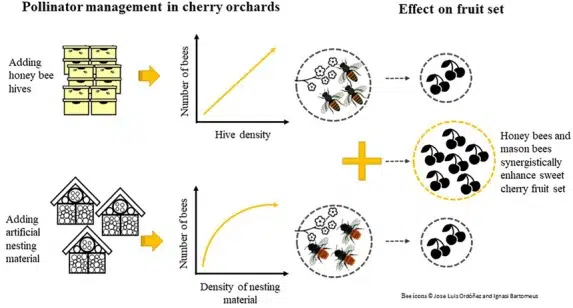
How did researchers study mason bees and honey bees?
First, the researchers counted bee visits in the orchards. They also recorded the number of honey bee hives and the nesting material provided for mason bees. To see whether more pollen could make a difference, they compared flowers open to insects with flowers they pollinated by hand. Read the sweet cherry orchard study.
What does fruit set mean?
Fruit set is the share of flowers that start to form fruit. In this study, 28% of flowers visited by insects set fruit. When researchers placed pollen by hand under favorable conditions, that figure reached 39%. The difference suggested a pollen shortage in the orchards they studied. It does not tell a grower how many cherries a different orchard will produce.
Why look for more than one kind of orchard bee?
Higher bee numbers were associated with better fruit set when mason bees and honey bees occurred together. The researchers did not find that same pattern when just one group was present. An orchard in another climate can have a different mix of visitors, so the result is a reason to observe local trees before making a management decision.
For example, look for a mason bee with loose pollen on the underside of her body. A honey bee may carry a compact pollen load on each hind leg. Watch a flowering branch for a few minutes and jot down who visits. Then return after the petals fall and look for tiny developing fruit. Those observations are a starting point for a conversation with a local orchard specialist.